Abstract: Platinum, palladium, and rhodium are core strategic platinum group metals (PGMs) widely applied in automotive exhaust purification catalysts and high-end chemical catalysis. The removal of iron impurities from precious metal feed solution is a key procedure in PGM refining. Traditional impurity removal technologies including hydrolysis, conventional ion exchange, and solvent extraction easily cause secondary dispersion loss of platinum, palladium and rhodium, resulting in decreased metal recovery rate and product purity. In this study, a state transformation and redissolution technology without precious metal dispersion loss was developed, and an integrated refining process consisting of state transformation and redissolution, ion exchange base metal removal, fractional solvent extraction, and rhodium enrichment refining was established. The experimental results show that the proposed process can efficiently remove various base metal impurities with excellent direct recovery rates of PGMs. It fundamentally solves the precious metal loss problem of traditional technologies and realizes high-purity separation of PGMs, which meets the industrial production requirements of precursors for automotive exhaust purification catalysts.
Keywords: platinum group metals; state transformation and redissolution; ion exchange; solvent extraction; separation and refining; iron removal and impurity purification
1 Introduction
Platinum group metals including platinum, palladium and rhodium possess excellent catalytic activity, chemical stability and high-temperature resistance, serving as irreplaceable strategic functional materials in new energy, environmental catalysis and fine chemical industries. Automotive exhaust purification catalysts represent one of the most important application scenarios for PGMs. In industrially recovered PGM mixed feed solutions, iron is the most dominant and influential impurity, accompanied by a variety of base metals such as lead, tin, zinc, bismuth, antimony, copper, aluminum, calcium and silicon, which seriously restrict the purity and service performance of final PGM products.
Conventional purification methods such as hydrolysis, traditional ion exchange and ordinary solvent extraction frequently cause adsorption entrainment, coprecipitation and emulsification dispersion of PGMs during impurity removal. These problems lead to secondary loss and dispersion of precious metals, reduce the direct recovery rate, and increase subsequent refining load and production cost. In addition, the mixed precious metal solution treated by traditional processes cannot satisfy the production requirements of high-end catalysts. At present, the mainstream precursors for automotive exhaust catalysts are platinum, palladium and rhodium nitrates as well as platinum ethanolamine compounds. The synthesis parameters, component ratios and carrier impregnation sequences of different precursors are strictly differentiated, making unseparated mixed PGM solutions inapplicable for precise industrial preparation. Therefore, high-purity individual separation and refining of PGMs are indispensable. Developing a novel refining process with low loss, high impurity removal precision and high recovery rate has important engineering application value.
2 Experimental Section
2.1 Overall Process Principle
Aiming at the technical bottleneck of precious metal dispersion loss in traditional processes, this study innovatively adopts state transformation and redissolution technology as the core pretreatment procedure to avoid precious metal loss in conventional purification processes. Combined with deep base metal removal via ion exchange and fractional selective solvent extraction, stepwise separation and high-precision refining of platinum, palladium and rhodium are realized. The overall process flow is summarized as follows: precious metal feed solution → state transformation and redissolution upgrading → deep base metal removal by ion exchange → palladium extraction with S201 extractant → platinum extraction with TBP extractant → rhodium enrichment and refining from raffinate, yielding high-purity single-component platinum group metal products.
2.2 Core Procedures and Experimental Methods
2.2.1 State Transformation and Redissolution Technology
As the core innovation of the proposed process, the state transformation and redissolution technology regulates the physical and chemical properties and dissolution system of the feed solution. It reconstructs the existing forms of precious metal ions without dispersion loss, and removes colloidal impurities, suspended fine precious metal particles and complex impurities in the solution. Consequently, a high-concentration, high-purity and high-stability homogeneous mixed solution of platinum, palladium and rhodium is obtained. This pretreatment procedure fundamentally eliminates the risk of secondary precious metal dispersion in subsequent impurity removal and extraction processes, providing high-quality raw materials for high-precision PGM separation and refining.
2.2.2 Deep Base Metal Removal by Ion Exchange
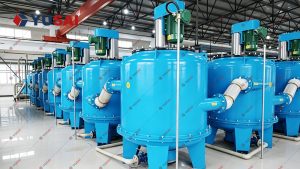
Strong-acid styrene-based cation exchange resin (model 732 / 001×7) was applied for deep removal of base metal impurities. The resin pretreatment was implemented in strict accordance with industrial standards: the resin was thoroughly cleaned with deionized water to remove surface dust and residual impurities, activated by hydrochloric acid soaking to restore ion exchange activity, and repeatedly washed with deionized water until the pH value of the eluate stabilized at 5–7. The pretreated resin was then loaded into the exchange column for use.
The PGM mixed solution after state transformation and redissolution was treated by a two-stage series ion exchange process. Cation exchange efficiently adsorbed base metal cations including iron, lead, zinc, copper, calcium and magnesium, while PGM complex anions were not adsorbed by the resin and remained in the effluent, realizing efficient separation of precious metals and base metals. The saturated resin was regenerated regularly, and trace platinum, palladium and rhodium entrained in the regeneration solution were recovered via zinc replacement to further reduce precious metal loss.
2.2.3 Fractional Solvent Extraction for Stepwise Separation
Fractional selective solvent extraction was adopted to separate individual PGMs from the high-purity mixed solution after deep ion exchange purification. Palladium was selectively extracted using S201 extractant for independent separation. Subsequently, platinum in the palladium-extracted raffinate was selectively extracted with TBP extractant to achieve precise platinum separation. The final raffinate was highly enriched with rhodium and directly delivered to the subsequent refining procedure for high-purity rhodium production. The fractional extraction system features high selectivity and low mutual entrainment, ensuring excellent separation purity and recovery rate of each single platinum group metal.
3 Results and Discussion
3.1 Purification Performance of Ion Exchange Treatment
The two-stage ion exchange process exhibited excellent performance in base metal impurity removal. The detection results show that the concentrations of iron, lead, tin and zinc in the treated effluent were all lower than 0.0005 g/L, while the contents of bismuth, antimony, copper, aluminum, magnesium, calcium and silicon were all below 0.0001 g/L. The thorough removal of trace base metal impurities fully meets the raw material requirements for high-purity platinum group metal refining.
The process achieved outstanding precious metal recovery performance. The single-pass direct recovery rates of platinum, palladium and rhodium in the ion exchange procedure reached 99.68%, 99.67% and 99.11%, respectively, with extremely low metal loss. The concentrations of precious metals in resin regeneration wastewater were extremely low: platinum 0.007 g/L, palladium 0.031 g/L, and rhodium 0.016 g/L. Trace precious metals in wastewater can be completely recovered by zinc replacement, realizing near-zero loss of platinum group metals and significantly improving resource utilization efficiency.
3.2 Advantages of the Integrated Process
Compared with traditional hydrolysis, single extraction and conventional ion exchange processes, the proposed technology fundamentally solves the secondary dispersion loss problem of platinum group metals. The state transformation and redissolution pretreatment stabilizes the ionic state of precious metals and avoids colloidal dispersion, coprecipitation and loss of PGMs during purification. The two-stage ion exchange achieves deep base metal removal without precious metal adsorption loss, and the fractional selective extraction system provides high separation precision without mutual interference between different metal components.
Experimental verification indicates that the PGM mixed solution treated by the proposed process can be directly reduced by hydrazine hydrate (N₂H₄·H₂O) to produce high-purity ternary mixed PGM powder. Nevertheless, for industrial production of automotive exhaust purification catalysts, the requirements for catalyst precursors are extremely stringent. Different nitrate precursors and platinum ethanolamine compounds have distinct synthesis ratios and carrier impregnation procedures. Mixed PGM solution or mixed metal powder cannot meet the precise production standards. Therefore, stepwise separation into high-purity individual platinum, palladium and rhodium products is essential for qualified manufacturing of high-end automotive exhaust catalysts.
4 Conclusions
The integrated platinum group metal refining process combining state transformation and redissolution, ion exchange impurity removal and fractional solvent extraction effectively overcomes the technical defects of traditional technologies, including secondary precious metal dispersion, low recovery rate and insufficient impurity removal precision. The innovative state transformation and redissolution technology prepares high-stability and high-concentration PGM mixed solution and controls precious metal loss from the source. The matched two-stage cation exchange process realizes deep removal of various base metal impurities to trace levels. Stepwise extraction with S201 and TBP achieves accurate separation of palladium and platinum, while rhodium is efficiently enriched in raffinate, ensuring excellent direct recovery rates for all PGM components.
This process features low metal loss, high separation precision, stable operation and excellent industrial adaptability. It can stably produce high-purity individual platinum, palladium and rhodium products that fully satisfy the precursor production requirements of automotive exhaust purification catalysts. Meanwhile, it provides a reliable technical reference for PGM refining in chemical catalysis and advanced precious metal material industries, possessing prominent industrial promotion value and economic benefits.